Renovate or knock down rebuild: How to Decide What’s Right for You

Renovating is usually the better move if your home’s frame, footings and plumbing are sound and you only need to update finishes, add a room or open up the living space. A knock down rebuild tends to make more sense once the layout genuinely fights against how you live, the house has bigger structural issues, or your renovation quotes start creeping close to what a brand new home would cost. The only way to know for sure is to get quotes for both and compare them side by side.
If you’ve been eyeing off that tired kitchen or a floor plan that never quite worked for your family, you’re probably asking the same question a huge number of Aussie homeowners ask every year. Should you renovate, or is it time to knock down and start again? Working out whether to renovate or knock down rebuild comes down to more than gut feeling, and there’s no single right answer for everyone. In this article, we’ll walk through how to spot when a renovation will do the job, when a full rebuild makes more sense, what actually drives the cost difference, and a few practical factors that tend to get missed until it’s too late to change course.
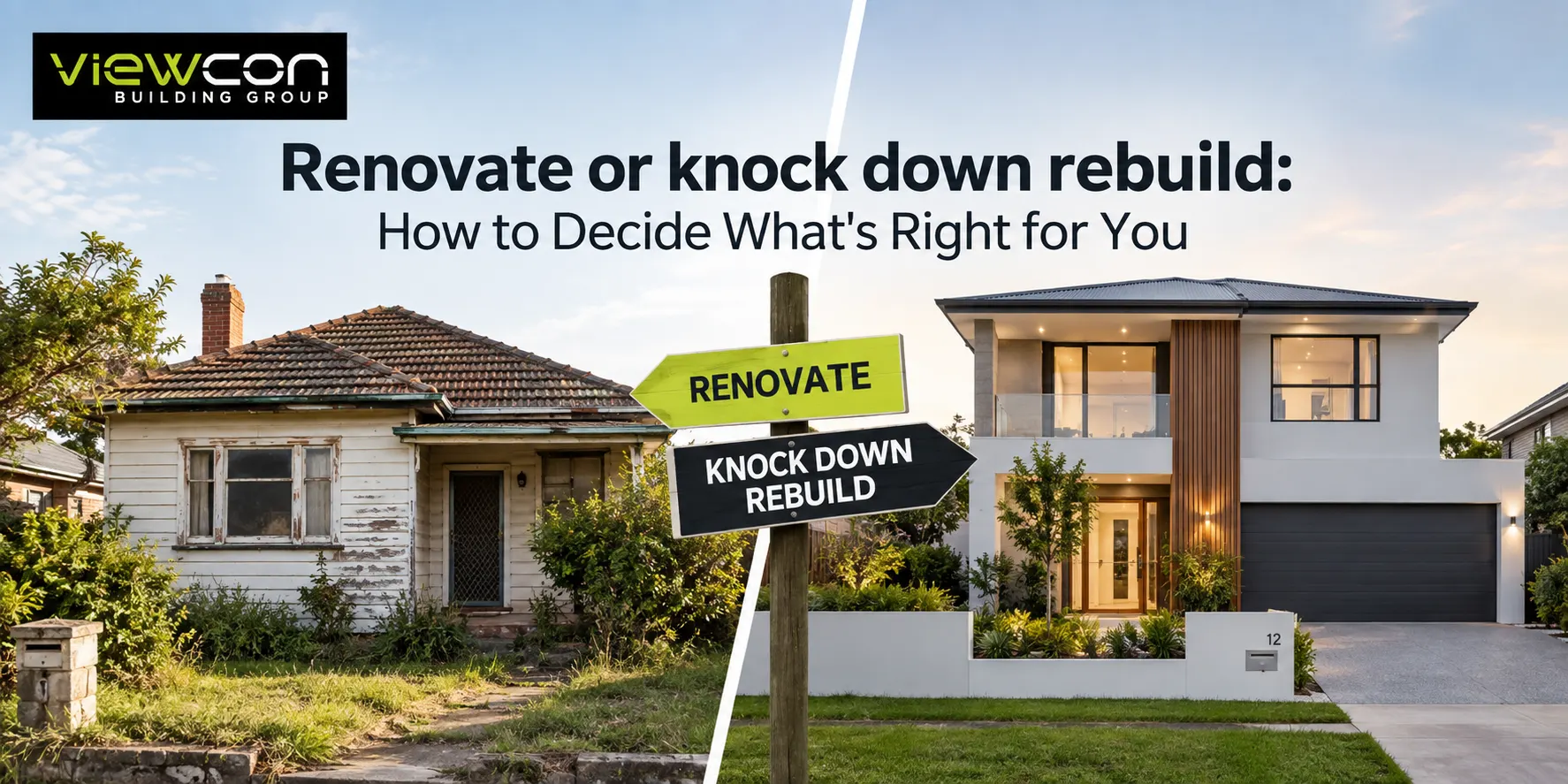
Renovate or knock down rebuild comparison showing an old home and a modern new home.

Why more homeowners are weighing this up right now

This isn’t a small trend. According to the Australian Bureau of Statistics, knock down rebuilds accounted for close to one in five of all new dwellings approved across the country over the past six years, and that share has been climbing in established suburbs close to city centres (ABS, Approvals of Knock-Down Rebuilds). It’s not hard to see why. Buying an equivalent home in a suburb you already love has become genuinely expensive, and moving comes with its own costs: stamp duty, agents’ fees, and the hassle of packing up a life. For a lot of families, staying put and rebuilding on the block they already own is starting to look like the more sensible option, financially and emotionally.

Signs a renovation will probably do the job

Not every tired house needs to come down. A renovation usually makes sense when:

  • The bones of the house, meaning the frame, roof and footings, are in decent shape
  • You’re mostly unhappy with finishes, layout flow or lack of natural light rather than the structure itself
  • Your budget is tighter and you want to spread the work over stages
  • You genuinely love the street and the block’s orientation already works well for your home
  • Council restrictions or heritage overlays would make a full rebuild difficult anyway

If most of these sound like your situation, a well-planned renovation, even a fairly ambitious one, can get you most of the way to your dream home without the cost and disruption of starting from scratch.

Signs it’s time to knock down and rebuild

On the other hand, a rebuild tends to be the smarter call when:

  • The house has serious structural, damp or termite issues that would need fixing before any renovation work could even begin
  • The existing layout just doesn’t suit modern family life, and no amount of knocking out walls will fix it
  • Your block faces the wrong way for natural light and there’s no practical way to correct that without starting again
  • Renovation quotes are landing close to 70 to 80 per cent of what a new build would cost
  • You want the energy efficiency, insulation and comfort that current building standards deliver, which older homes were never designed for

Once quotes for a major renovation start closing in on rebuild territory, most homeowners find the decision makes itself.

Comparing the real costs, not just the first quote

This is where a lot of people get caught out. A renovation quote often looks cheaper on paper, but older homes have a habit of hiding surprises behind the walls, outdated wiring, asbestos, footings that need underpinning, and those extras can blow a budget out fast. A knock down rebuild, by comparison, tends to be more predictable once demolition and the new build are priced together under one fixed contract, because you’re building to current standards from a clean slate rather than working around what’s already there.

If a rebuild is starting to look like the better fit for your situation, it helps to work with a team that manages the whole process under one roof rather than juggling a demolition contractor and a separate builder. Viewcon Group’s knockdown rebuild service covers everything from demolition through to handover, which takes a lot of the guesswork out of budgeting for both stages at once.

A few things people forget to weigh up

Beyond the headline cost, there are a handful of practical factors worth thinking through before you commit either way:

  • Land value. In older, established suburbs, the land often makes up most of the property’s value, which tips the maths further in favour of rebuilding.
  • Approvals and overlays. Heritage overlays, easements or council restrictions can limit what you’re allowed to do with either option, so it pays to check early.
  • Timeline and disruption. A staged renovation can sometimes let you keep living at home, while a rebuild usually means finding somewhere else to stay for several months.
  • Resale down the track. A modern, energy efficient rebuild can appeal to a different pool of buyers than a renovated older home, which matters if you might sell one day.

None of these factors are deal breakers on their own, but they’re worth putting on the table before you sign anything.

Conclusion:

If you’re still torn, ask yourself these three questions. Is the structure of your current home actually sound, or are you patching around bigger problems? Would a new layout genuinely solve what’s frustrating you, or is it really about finishes and light? And are your renovation quotes creeping close to what a rebuild would cost anyway? Your answers usually point pretty clearly toward one path or the other.

There’s rarely a universally right answer when it comes to deciding whether to renovate or knock down rebuild, it really comes down to the condition of your current home, your budget, and how well your block already works for the life you want to live. What matters most is getting honest, apples-to-apples numbers for both options before you commit either way. If you’d like a professional opinion on which path makes more sense for your block, get in touch with the team at Viewcon Group and we’ll talk you through your options.


1. How do I know if my house is a good candidate for renovation instead of a rebuild?
Generally, if the frame, roof structure and footings are sound and in good condition, renovation is worth considering. Get a building inspection first, since hidden issues like termite damage, subsidence or ageing wiring can turn a simple renovation into a much bigger job. If the inspection comes back clean and you're mainly unhappy with layout or finishes, renovating is often the more cost effective path forward for your family and budget.
2. Is it cheaper to renovate or knock down and rebuild?
It depends entirely on the home. Smaller cosmetic renovations are usually cheaper upfront, but major structural renovations can end up costing close to a new build once you factor in unexpected repairs. A knock down rebuild has a higher starting cost but tends to be more predictable, since you're building fresh to current standards rather than working around existing problems that often surface once work begins.
3. How long does a knock down rebuild take compared to a renovation?
A knock down rebuild typically takes longer overall, often ten to fourteen months from demolition through to handover, because it includes approvals, demolition and a full build. A moderate renovation might take three to six months, though major structural renovations can stretch out longer, especially if unexpected issues are found once walls come down and the true state of the home is revealed.
4. Do I need council approval to knock down and rebuild my house?
Yes, in almost every case you'll need a demolition permit as well as a building permit for the new home, and depending on your council, a planning permit too. Requirements vary based on your property's zoning, overlays and location, so it's worth checking with your local council or builder early in the process to understand what applies to your specific block before you commit to a timeline.
5. Can I stay living in my house during a renovation?
Sometimes, particularly with staged or smaller renovations that don't touch essential living areas like the kitchen or bathroom. Larger structural renovations usually make living at home difficult or unsafe, especially once walls, plumbing or electrical work are involved. Your builder can usually tell you upfront whether your specific renovation plan will require you to move out temporarily, and for how long.
6. What happens to the old materials when a house is demolished?
Licensed demolition contractors typically salvage and recycle what they can, including bricks, timber, metal and roofing materials, before the rest goes to landfill. Homes built before the 1990s often contain asbestos, which needs to be identified and removed by a licensed specialist before general demolition begins. A reputable demolition team will handle this process safely and provide documentation confirming it's been done correctly.
7. Does a knock down rebuild increase my property's value more than a renovation?
Often, yes, particularly in established suburbs where land value makes up a large share of the property's worth. A brand new home built to current standards can appeal to a broader pool of future buyers than a renovated older property, especially one where the renovation didn't fully resolve layout or orientation issues. That said, the actual value uplift always depends on your specific suburb and market conditions.
8. Is a knock down rebuild worth it if I love my current neighbourhood?
Absolutely, that's actually one of the main reasons homeowners choose to rebuild rather than sell. It lets you keep the school zone, the neighbours, the commute and the community you already know, while getting a home that's designed around how you actually live. For many families, it works out more practical and often more affordable than trying to buy an equivalent home in the same area.
Viewcon Building Group

Viewcon Building Group

Let's Build Something Beautiful Together

.