A developer prepares and sells the land, handling site acquisition, subdivision, zoning, and infrastructure like roads and utilities. A builder constructs the actual home on that land, managing everything from foundations and framing to trades, materials, and final handover. Developers work at the estate or land level; builders work directly with you on your house. The simplest way to remember it: developers set the stage, builders deliver the house, and once your land settles, it’s your builder you’ll be dealing with day to day.
If you’re about to build your first home in Melbourne’s northern suburbs, you’ve probably heard the terms “builder” and “developer” used like they mean the same thing. They don’t. In this guide, we’ll break down what each one actually does, who’s accountable for what during your build, and why understanding builder vs developer roles early on can save you a lot of confusion (and a few headaches) before you sign anything. By the end, you’ll know exactly who you should be talking to at each stage of your project.
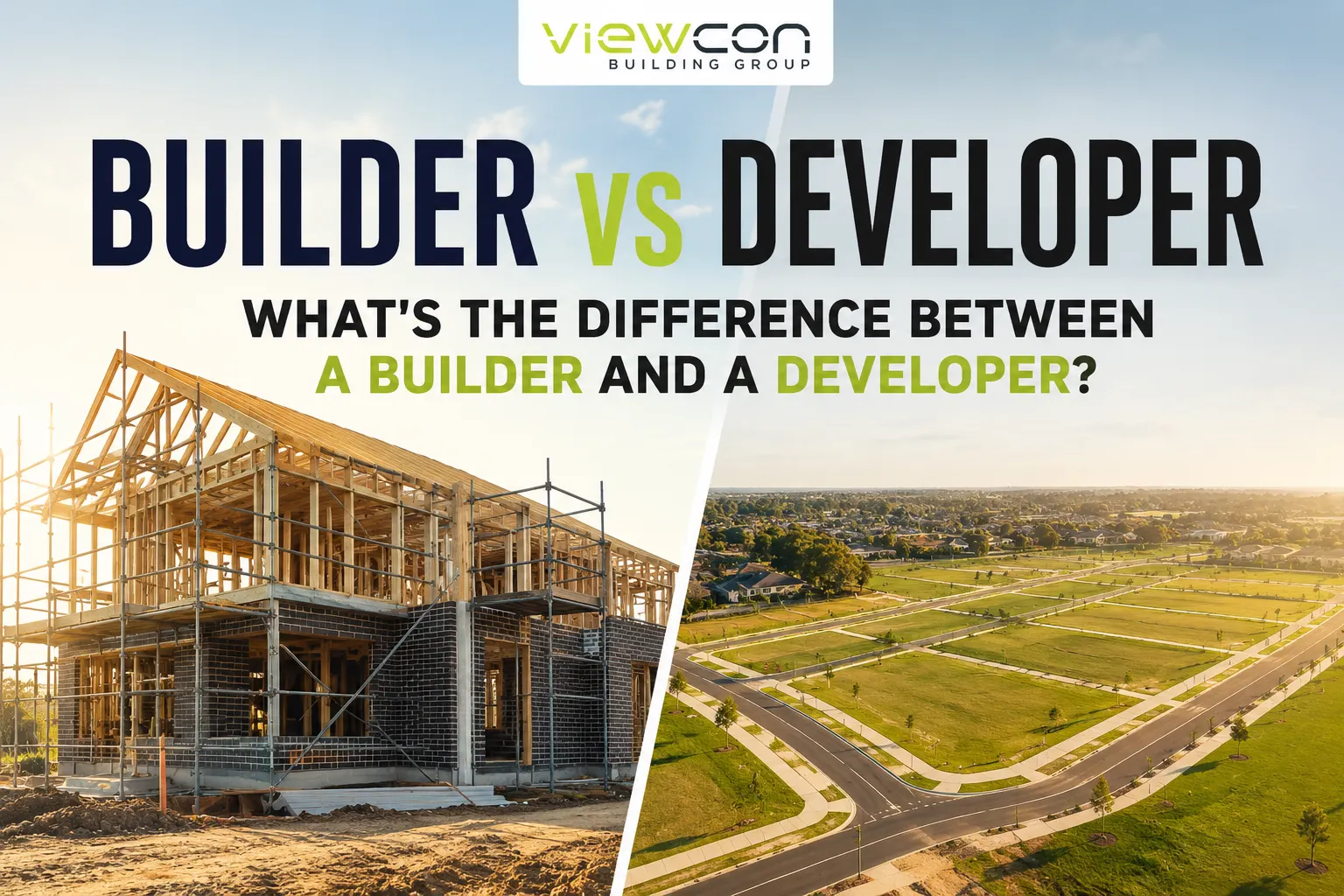
It’s an easy mix-up to make. Both builders and developers show up in property conversations, both deal with land, permits, and construction, and both are trying to get a house built. But the similarities pretty much stop there.
A developer works at the front end of a project. Think land acquisition, subdivision, zoning approvals, and getting an estate or block ready for someone to actually build on. Developers are the ones doing feasibility studies, sorting out titles, and putting in the roads, drainage, and utility connections before a single brick gets laid. Their focus is the big picture, turning raw or underused land into something buildable and sellable.
A builder, on the other hand, is the one who actually constructs your home. Once the land is ready, a builder works directly with you (or your design) to bring the house itself to life, foundations, framing, brickwork, electrical, plumbing, right through to the final handover of keys. A good custom builder will also guide you through material selections, floor plans, and council requirements specific to your build, rather than just following a generic template. This is especially true if you’re after a luxury home, where the finish, fittings, and finer details matter just as much as the structure itself.
In short: developers prepare the land, builders create the home.
The overlap happens because in a lot of new estates, you’ll deal with a developer first (buying your land) and a builder second (constructing your house), sometimes without anyone clearly explaining the handover between the two. In other cases, larger companies operate as both, managing the land release and the construction under one roof, which blurs the line even further for someone building for the first time.
This matters more than it might seem. If something goes wrong with your titles, easements, or estate covenants, that’s a developer issue. If something goes wrong with your build quality, timelines, or trades, that’s on the builder. Knowing who’s responsible for what means you’re not left chasing the wrong party when an issue actually comes up, and it means you ask the right questions of the right person from day one.
For anyone who hasn’t built before, this isn’t just industry trivia, it directly affects how hands-on and accountable your experience will be. A developer’s job typically ends once your land settles. From there, your relationship, your contract, and your day-to-day communication belong almost entirely to your builder. That’s why choosing a builder who treats a custom or luxury home as a genuine partnership, rather than a volume-built, one-size-fits-all product, makes such a difference to first-time buyers navigating the process solo.
This is really the heart of the builder vs developer question for someone starting out: a developer sells you the opportunity to build, but a builder is who you’ll actually be working with for the next 8–12 months (or longer), through design meetings, site visits, variations, and everything in between. If you’re weighing up your options in Melbourne’s northern growth corridor, it’s worth looking at how a custom home builder approaches this relationship, particularly around communication, transparency on inclusions, and how involved you get to be in decisions along the way. This matters just as much whether you’re building an everyday family home or working with luxury home builders on something more high-end, since the level of hands-on guidance you get shouldn’t change based on the size of your build.
● Developer = land, planning, infrastructure, estate-level decisions
● Builder = your actual house, your contract, your day-to-day build experience
If you’re still in the researching phase, a simple rule of thumb helps: developers set the stage, builders deliver the performance. Your builder is who you’ll be calling if a tile’s cracked, a trade’s running late, or you want to tweak a room layout, not your developer.
Understanding the difference between a builder and a developer isn’t just about vocabulary, it shapes who you hold accountable, who you communicate with, and what kind of experience you can expect once you’ve committed to building. For first-time buyers especially, going in with this clarity means fewer surprises and a much smoother path from settlement to move-in day.
If you’re planning your first build in Mickleham, Craigieburn, Fraser Rise, or anywhere across Melbourne’s northern suburbs, whether it’s a family home or a luxury home build, and want a builder who’ll walk you through every stage in plain English, get in touch with Viewcon Group for a no-pressure chat about your project.
No. A developer handles land, buying it, subdividing it, securing approvals, and putting in roads and services. A builder is who actually constructs your home once that land is ready. They're separate businesses with separate responsibilities, even though buyers often assume one company handles both. In many estates you'll deal with a developer for your land purchase, then move on to a builder entirely for your house. Knowing this early avoids confusion about who to contact when.
That's a developer matter, not a builder one. Developers manage subdivisions, titles, easements, and estate covenants, so any dispute or delay around your block itself sits with them. Your builder isn't involved in land preparation and generally can't resolve title issues. If you're unsure who's responsible for something, it usually comes down to whether the problem relates to the land (developer) or the physical build (builder).
Yes, some larger companies manage the full process, releasing land and constructing homes under one business. This can simplify communication, but it doesn't remove the distinction between the two roles internally. It's still worth understanding which team handles land matters and which handles construction, so you know who's accountable at each stage, even when you're dealing with a single company for the whole project.
Because accountability shifts depending on the stage you're at. Land issues, like drainage or boundary problems, are a developer's responsibility. Build issues, like trade delays or workmanship, are a builder's responsibility. If you don't know the difference, you risk raising concerns with the wrong party, which wastes time and can delay resolutions. Understanding the split means you always know who to approach first.
Sometimes, particularly in house-and-land packages where a developer partners with specific builders. Other times, once you own the land, you're free to choose any builder you like, including a custom builder outside the estate's preferred list. It's worth checking your land contract early, since some estates include design or builder restrictions that affect your options later on.
Once settlement is complete, the developer's involvement in your day-to-day experience largely ends. From there, your relationship shifts almost entirely to your builder, who takes over design finalisation, approvals, construction, and communication through to handover. This is why choosing the right builder matters just as much as choosing the right land, since they'll be your main point of contact for the bulk of the project.
Not quite. A project manager typically works on behalf of you or the builder to coordinate trades, timelines, and approvals during construction. A developer, by contrast, works earlier in the process, focused on land and infrastructure rather than day-to-day build coordination. The terms sometimes get used loosely, but their roles and responsibilities don't overlap in practice.
It's a good idea, since builders working within a particular estate are usually familiar with any developer-imposed design guidelines, such as facade requirements or minimum build sizes. While these restrictions come from the developer, your builder often has to design within them, so raising it early avoids surprises once plans are drawn up.
That falls under the developer's scope. Developers are responsible for preparing an estate before blocks are sold, which includes roads, drainage, footpaths, and utility connections. Builders rely on this infrastructure being in place before construction starts, but they aren't responsible for installing or maintaining it themselves. Any concerns about estate-wide infrastructure should go to the developer.
Yes, significantly. First-time buyers who understand the split tend to ask clearer questions, know who to contact when issues arise, and feel less overwhelmed navigating land purchase versus construction. It also helps set realistic expectations about who you'll be working with long-term, since your builder relationship lasts far longer than your interaction with the developer.

Talha Lone is a Digital Marketing and Business Growth Professional with experience supporting brands in building a stronger online presence and achieving sustainable business growth. His expertise spans digital strategy, paid advertising, SEO, content marketing, and lead generation. As a liaison for agencies and startups, Talha works with businesses across diverse industries to increase digital visibility, attract potential customers, and drive measurable results. With a focus on practical strategies and long-term growth, he helps brands turn digital opportunities into meaningful business outcomes.